
Ted Talk

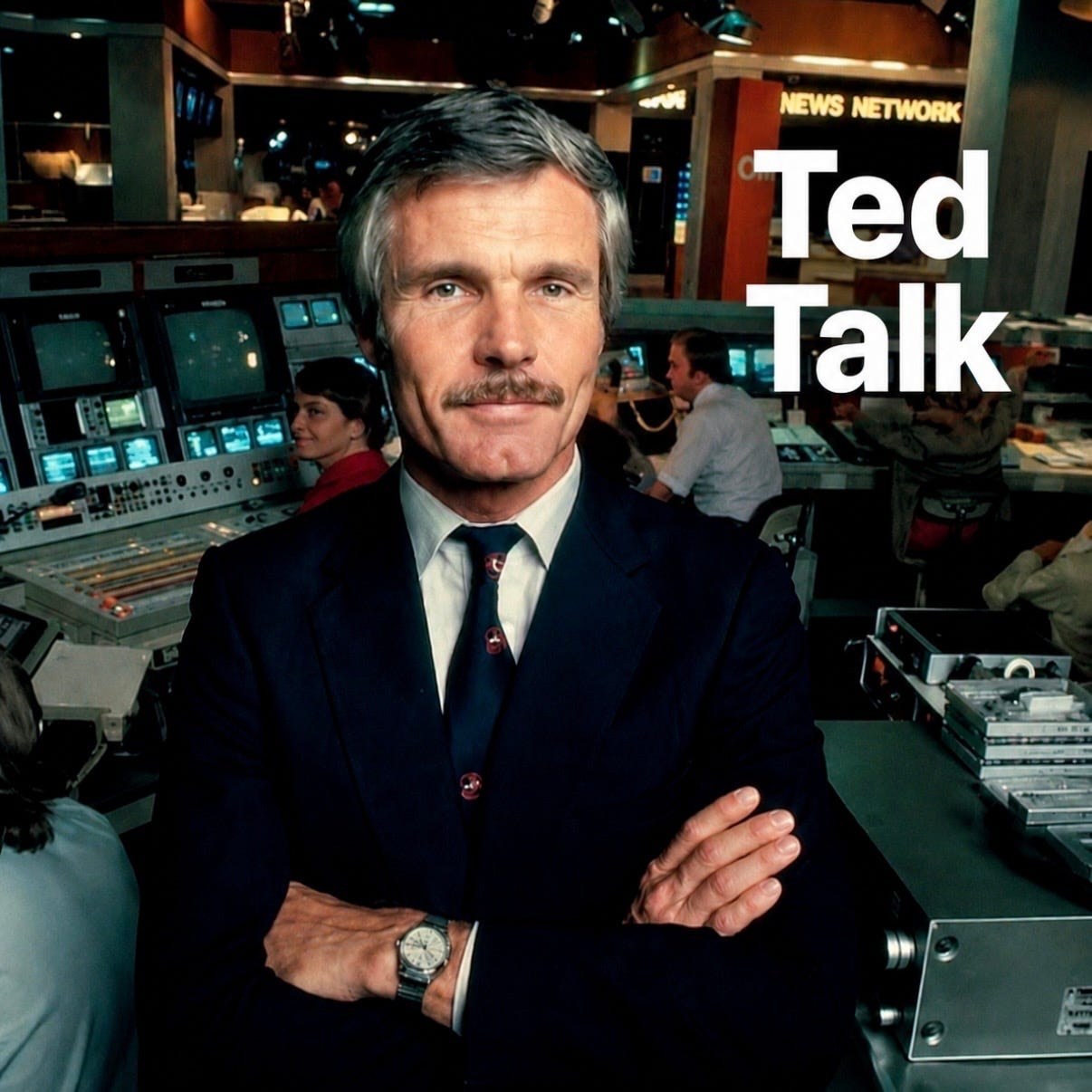
Ted Turner walked into CNN’s booth at a cable show in Las Vegas wearing a colorful madras sport coat and lime green pants. It was the day after St. Patrick’s Day, 1982.
He had recently hired legendary daytime host Mike Douglas—well past his prime—to anchor a nightly “celebrity” show, clearly to impress cable operators and help drive distribution for his fledgling network. I was a 22-year-old associate producer on a staff of five. No one was older than 25.
We’d taken the show to a Vegas showroom so Ted could show off his newly acquired “star.”
I’m not sure what I was thinking. Ted was my boss’s, boss’s, boss’s boss. I’d met him once or twice before—he’d pass through CNN’s LA bureau and was always approachable, if a bit irascible (“Who do I need to f*** to get a pencil around here?”).
While I while staring at those lime green pants I somehow blurted out:
“Ted, what’s with the green pants? St. Patrick’s Day was yesterday.”
He grinned and said in that unmistakable drawl:
“Ahhh know… I got so drunk last night, I fell asleep in my clothes and didn’t feel like changing this morning.”
End of conversation.
Back then, CNN—and really most cable channels—were startups. We just didn’t call them that. No one knew what they were supposed to be. Nobody had cable, Ted was best known as the winner of the America’s Cup, and everyone thought a 24 news channel was a terrible idea.
CNN was a mix of grizzled news vets (many otherwise unemployable for various reasons) and cheap, just-out-of-college kids. It was like graduate school. Who else would hand some twenty-somethings an hour of live national television five nights a week? (Okay it was on 1AM ET/10PM PT. But still.)
Later, I would have the “privilege” of producing segments with Ted’s not-so-secret LA girlfriend, model/actress Liz Wickersham. The rule at CNN was: if hard news needed a camera crew, they got it—no matter what we were shooting. One time, on location with Liz, we got that call. I declined—and told the news desk that unless they wanted to personally tell Ted we were pulling her crew, I was keeping it.
I worked at CNN from launch in June 1980 until August 1983. In 1984, Ted decided to start a music channel to compete with red hot cable sensation, MTV. Somehow, both channels simultaneously offered me jobs. And yes—I turned MTV down to go with Ted.
Once again, I don’t know what I was thinking.
A week before starting with Turner, MTV’s Bob Pittman and John Sykes talked me out of it at on the goal line. I ultimately went to MTV, where my career took off. Ted’s music channel lasted barely a month. One of his rare misses.
I crossed paths with him one last time in the late ’90s, when I was running Comedy Central—a joint venture between Viacom and Time Warner that was just finding it’s footing. After South Park exploded in ’97, my Time Warner boss Jeff Bewkes called: “You’ve got Ted’s attention, He wants to come “kick the tires.”
We did the full dog-and-pony show. Not without some hiccups. His chair in the conference room broke when he sat in it. Afterward, he asked for a tour. We were small then—maybe 100 people across two floors. As we walked, he shook hands, asked questions and wondered why one of the offices had beads hanging rather than a door. Then he pointed to a conference room full of guys in white shirts.
“What’s going on in there?”
“That’s the finance department,” I said.
“Why do you need a finance department?” he shot back. “You guys don’t make any money!”
Fair point.
I never saw him again, but I always made a point to hear him speak when I could. He never disappointed.
Ted Turner was fearless, brilliant, and chaotic. A swashbuckling, problematic visionary. One of the true architects of the cable business.
One-of-one.
Love him or hate him, his impact is undeniable.
RIP Ted
Loved this, Doug.
Thanks for sharing, Doug! As a huge fan of The Critic, my first real exposure to Ted Turner was the character of Duke Phillips. At the time I needed my parents to explain the reference. The first time I saw Ted speak I was amazed at how closely the writers got to reality. Deep down it motivated me to be a writer.